Documentation
This documentation is a work in progress. Check out videos on the ultraPacer YouTube Channel. Feature requests or issue/bug reports? Suggest, vote, and comment in the Feedback Hub.
Anything else? Contact me directly.
The models below are applied for pacing calculations.
- Grade is defined automatically by elevation data in the GPX track
- Altitude is defined automatically by elevation data in the GPX track
- Terrain is manually defined by setting Waypoint “Terrain Factors”
- Heat is optionally input for each Plan
- Darkness is calculated based on terrain and sunrise/sunset times
- Strategy is optionally input for each Plan
Grade
The grade model is shown below. Upgrades require more effort than flat terrain. Downgrades require less effort, to a crossover point at about -16%, where it starts to become more difficult again.
Downhill Skill
Users can adjust their downhill running skill on the Settings page or for coached athletes via the Athlete card. Higher values indicate stronger downhill ability, resulting in faster descents on shallow downgrades and reduced impact on steep downgrades. Lower values indicate weaker downhill ability, reducing speed benefits on downgrades. This adjustment only affects the downhill (negative grade) portion of the grade model.
Altitude
The altitude model is an exponentially increasing factor. The default model has a lower threshold of 750 meters, under which altitude is assumed to be insignificant. Above 750 meters, the time to run a given distance increases at a rate of 6% every 1000 meters, compounded continuously. Users can adjust their altitude acclimatization on the Settings page.
This model is based on research from Jon Peter Wehrlin & Jostein Hallén [1], which indicates a 6.3% decrease in VO2,max per 1000m.
Terrain
The terrain model is manually input by waypoint and is based on course knowledge. It is intended to address anything that is too small to appear in elevation data. Terrain factors are defined by the course owner using the “Edit” buttons within the “Waypoints” tab. Typical value ranges by terrain type are:
- Paved: 0%
- Fireroad: 2-6%
- Doubletrack: 6-10%
- Singletrack: 10-20%
- Technical: 20-50% +
Heat
The heat model the top half of a sinusoidal curve. A “baseline” heat factor can be applied outside of peak hours. The heat model activates 1/2 hour after sunrise and returns to baseline 1 hour after sunset, peaking at a maximum value as specified. A heat model can be defined for each plan. If no heat model is defined, no heat factor is used.
Darkness
From dusk to dawn, a darkness factor equal to the terrain factor is applied (essentially doubling the terrain factor). During twilight hours (from dawn to sunrise and sunset to dusk), the darkness factor is linearly applied between nothing (daytime) and the full darkness factor.
Users can personalize the affect of darkness on the Settings page.
Pacing Strategy
Pacing strategy is intentional/planned changes in level of effort through the race. It can be linearly applied, reducing time per distance at the beginning of the race and increasing at the end of the race, or by more advanced models. Pacing strategy is defined by the user for each plan.
Unless otherwise specified, defaults are applied as a linear degradation throughout, to factor in typical fatigue, applied based on the overall course/race distance:
- 30 km and under: 2%
- 30 - 60 km: 5%
- 60 to 90 km: 10%
- 90 to 120 km: 15%
- 120 km and over: 20%
See Create/Modify Plans for more on modifying strategy.
Research/Improvement Opportunities
“All models are wrong, but some are useful.” - George Box
Additional research can help to improve the models underpinning ultraPacer. Topics that could use better support are:
- Influence of down-grades as a function of time/distance/fatigue (we all know that going downhill gets harder late in a long event). Note: The downhill skill adjustment addresses athlete proficiency on descents, but does not yet model fatigue-related changes in downhill performance over the course of a race.
- Separating influences of humidity, exposure, and temperature from the generic “heat” model.
If you know of existing research that could/should be incorporated into ultraPacer, please send it my way.
We are also able to provide (minimal) financial assistance for graduate students or professors who are interested in pursuing research that can further enhance ultraPacer’s capabilities.
Citations
- Wehrlin, J.P., Hallén, J. Linear decrease in and performance with increasing altitude in endurance athletes. Eur J Appl Physiol 96, 404–412 (2006). https://doi.org/10.1007/s00421-005-0081-9
What's new?
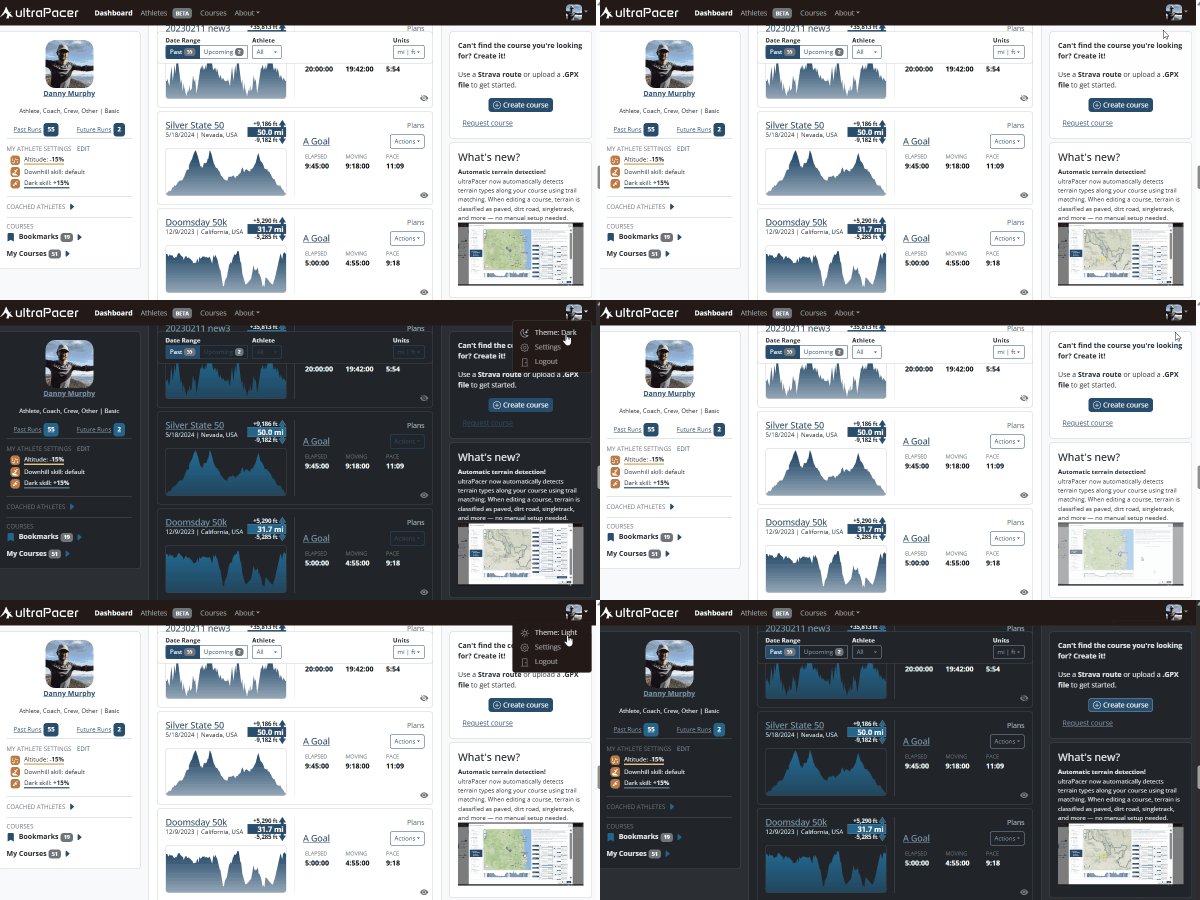
Dark mode is here!
ultraPacer now has a dark theme that’s easier on the eyes in low light. Tap the theme option in the menu to switch between light, dark, or auto — which follows your system setting.